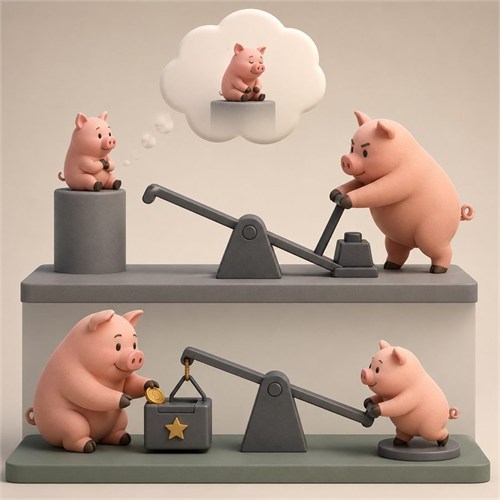
Spieltheorie; asymmetrisches Spiel; Beispiel für ein Nash-Gleichgewicht
Spieltheorie; asymmetrisches Spiel; Beispiel für ein Nash-GleichgewichtSpieltheorie der klugen Schweine
Smart Pig Game Theory
Wenn man der schwächere Spieler ist, kann es rational sein zu warten, wenn der stärkere ohnehin handeln muss; wenn man der stärkere Spieler ist, sollte man Anreize sorgfältig gestalten, damit man nicht immer selbst den Hebel drücken muss.
Beliebtheit
Nützlichkeit
Aliasse
Spiel der klugen Schweine / Spiel der rationalen Schweine / Spiel der eingesperrten Schweine / Schweinespiel
Bereiche
Ökonomie / Managementstrategie / organisatorische Anreizsysteme / evolutionäre Spieltheorie / Unternehmenswettbewerb
Definition
- Das Spiel der eingesperrten Schweine ist ein asymmetrisches Zwei-Spieler-Spiel, in dem ein starker Spieler und ein schwacher Spieler entscheiden, ob sie Kosten auf sich nehmen, um einen gemeinsamen Nutzen zu erzeugen. Im Standardmodell ist es für den schwachen Spieler optimal zu warten, während der starke Spieler die Kosten trägt.
Kerngedanke
- Ein schwächerer Spieler kann manchmal gerade dadurch einen Vorteil gewinnen, dass er nicht zuerst handelt, weil der stärkere Spieler einen größeren Anreiz oder mehr Fähigkeit hat, die Kosten zu tragen.
- Dadurch wird das "Warten" für den schwachen Spieler rational und das "Handeln" für den starken Spieler rational.
So funktioniert es
- Zwei Schweine werden in einen Verschlag gesetzt: ein großes / dominantes Schwein und ein kleines / untergeordnetes Schwein.
- Ein Hebel oder eine Platte an einem Ende setzt am anderen Ende Futter frei, doch das Drücken verursacht Kosten.
- Wenn das kleine Schwein drückt, kann das große Schwein das Futter zuerst erreichen oder beherrschen, sodass für das kleine Schwein nur wenig Nutzen bleibt.
- Wenn das große Schwein drückt, während das kleine Schwein in der Nähe des Futtertrogs wartet, profitieren beide in gewissem Maß.
- In Eric Rasmusens Lehrbuchfassung lautet das eindeutige Nash-Gleichgewicht: Großes Schwein drückt; kleines Schwein wartet.
Anwendungsbeispiel
- Ein kleines Unternehmen kann darauf verzichten, viel Geld dafür auszugeben, einen neuen Markt aufzuklären oder aufzubauen. Stattdessen wartet es, bis ein großes Unternehmen in Marketing, Infrastruktur oder Kundenaufklärung investiert, und tritt dann später mit einer günstigeren Imitation oder einem Nischenprodukt ein. Rasmusen nennt eine ähnliche Geschäftsanalogie: Wenn ein großes Unternehmen dafür bezahlt, eine neue Produktkategorie einzuführen, kann ein kleineres Unternehmen profitabel imitieren, ohne den Absatz des großen Unternehmens vollständig zu zerstören.
Bekanntes Beispiel
- Beispiel: Ein großes Schwein und ein kleines Schwein befinden sich in einem Gehege. Wenn ein Hebel gedrückt wird, wird am gegenüberliegenden Ende Futter freigesetzt. Das kleine Schwein wartet in der Nähe des Futtertrogs, während das große Schwein den Hebel drückt und zurückläuft.
- Warum es zu dieser Regel passt: Für das kleine Schwein ist die Strategie des Wartens besser als selbst zu drücken, weil das Drücken Kraft kostet und dem großen Schwein erlaubt, den größten Teil des Futters zu bekommen. Da das große Schwein das weiß, ist seine beste Antwort, selbst zu drücken, statt gar nichts zu erhalten.
Anwendungsfälle / Situationen, in denen es relevant ist
- Kleine Unternehmen, die warten, bis große Unternehmen einen Markt aufbauen oder aufklären.
- Trittbrettfahrerprobleme, bei denen eine Partei von der kostspieligen Handlung einer anderen profitiert.
- Situationen mit öffentlichen Gütern, in denen ein Spieler stärkere Anreize hat, etwas beizutragen.
- Organisationale Kontexte, in denen starke Leistungsträger gemeinsame Arbeit tragen, während schwächere oder machtärmere Mitglieder warten.
- Strategische Entscheidungen über den richtigen Zeitpunkt: zuerst handeln, warten, imitieren oder eine andere Partei die Einrichtungskosten tragen lassen.
Wann man es nicht verwenden sollte / Häufige Fehlanwendungen
- Verwende es nicht, wenn die Spieler hinsichtlich Macht, Kosten, Geschwindigkeit oder Zugang zu Vorteilen ungefähr gleich sind.
- Verwechsle es nicht mit dem Gefangenendilemma; das Spiel der eingesperrten Schweine ist asymmetrisch und hat nicht dieselbe Struktur des beiderseitigen Defektierens.
- Gehe nicht davon aus, dass "Warten" immer klug ist; es funktioniert nur dann, wenn der stärkere Spieler weiterhin genügend Anreiz hat zu handeln.
- Behaupte nicht, John Nash habe das Smart Pig Game persönlich erfunden, solange keine verlässliche Primärquelle vorliegt. Die geprüften Quellen stützen "Boxed Pigs" als spieltheoretisches Beispiel auf der Grundlage von Baldwins und Meeses Schweineexperiment von 1979, nicht als klar dokumentierte Erfindung durch Nash.
Ursprung / Entstehung
- Entwickelt von: Unbekannt als namentlich benannte "Spieltheorie der klugen Schweine". Das zugrunde liegende Experiment wird B. A. Baldwin und G. B. Meese zugeschrieben.
- Entstehungsjahr: Kein verifiziertes einzelnes Entstehungsjahr. Das zugrunde liegende Schweineexperiment wurde 1979 veröffentlicht; spätere spieltheoretische Lehrtexte verwenden es als "Boxed Pigs"-Beispiel.
- Land / Entstehungskontext: Verhaltensforschung an Tieren und Forschung zur operanten Konditionierung; später für die Lehre in Ökonomie und Spieltheorie adaptiert.
Kurze praktische Quintessenz
- Wenn man der schwächere Spieler ist, kann es rational sein zu warten, wenn der stärkere ohnehin handeln muss; wenn man der stärkere Spieler ist, sollte man Anreize sorgfältig gestalten, damit man nicht immer selbst den Hebel drücken muss.
