Unknown
UnknownZeigarnik Memory Effect
Starting a task and leaving a clear unfinished next step can make it easier to remember and return to, but the effect is context-dependent and should not be treated as a guaranteed memory law.
Popularity
Usefulness
Aliases
Unknown
Domains
Unknown
Definition
- The
Core Idea
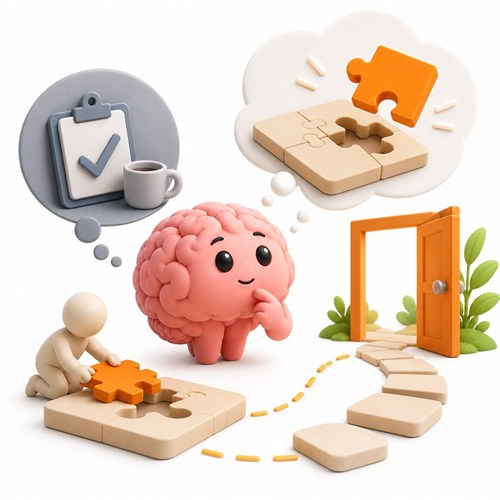
- An unfinished task can remain mentally active because the goal has not reached closure. This unresolved state may make the task easier to recall than a task that has already been completed.
How It Works
- A person starts a task and forms an intention to complete it.
- If the task is interrupted before completion, the intention may remain psychologically active.
Usage Example
- A student begins writing an essay but stops after creating the outline. Because the task is unfinished, the essay keeps coming back to mind, making it easier to resume later.
Famous Example
- Example: Bluma
Use Cases / Situations Where It Applies
- Studying: stop after starting a clear subtask so the mind keeps it active.
- Writing: pause after outlining or drafting a sentence to make re-entry easier.
- Product design: progress bars, unfinished onboarding steps, and saved drafts can encourage return.
- Storytelling: cliffhangers can keep an unresolved plot active in memory.
- Task management: writing down unfinished tasks can reduce mental load while preserving intention.
When Not to Use or Common Misuse
- Do not treat it as proof that unfinished work is always remembered better; modern evidence suggests the effect is not universally reliable.
- Do not confuse it with the Ovsiankina Effect, which is the tendency to resume interrupted tasks.
- Do not use it to justify creating unnecessary anxiety or endless “open loops.”
- Do not describe it simply as “people are born with a drive to finish everything”; that is too broad and not the standard definition.
Rule Invention / Origin
- Invented by: Not exactly “invented”; first reported by Bluma
Evidence / Research Basis
Short Practical Takeaway
- Starting a task and leaving a clear unfinished next step can make it easier to remember and return to, but the effect is context-dependent and should not be treated as a guaranteed memory law.
Current Working Summary
The