Cognitive bias; Social influence; Persuasion principle
Cognitive bias; Social influence; Persuasion principleAuthority Effect
Titles, uniforms, prestige, and institutional signals can speed up trust and obedience. Use them as context, not as a substitute for evidence.
Popularity
Usefulness
Aliases
Authority Bias / Authority Principle / Obedience to Authority / Expert Influence / Appeal to Authority: related fallacy, not the same concept
Domains
Social psychology / Behavioral economics / Marketing / Leadership / Education / Medicine / Decision-making
Definition
- The Authority Effect is the tendency to give extra credibility, weight, or obedience to a person or message because it seems official, expert, or institutionally backed.
- In psychology and behavioral writing, closely related labels include authority bias and the authority principle.
Core Idea
- People often treat authority as a shortcut for truth: “An expert, leader, doctor, professor, official, or famous institution said it, so it is probably correct.”
How It Works
- Authority cues such as titles, uniforms, credentials, institutional logos, expert language, social status, confidence, or professional setting increase perceived credibility.
- The listener may reduce independent checking because authority feels like a reliable mental shortcut.
- This can be useful when the authority is genuinely competent and accountable.
- It becomes risky when status replaces evidence, especially in high-stakes decisions.
Usage Example
- A customer is more likely to trust a skincare product if it is recommended by a dermatologist than by an unknown seller.
- A junior employee may accept a manager’s technical decision without questioning it, even when the decision has obvious flaws.
- A patient may follow a doctor’s advice because of medical authority, but should still ask for clarification when the advice is unclear.
Famous Example
- Example: Milgram's obedience studies examined how far participants would follow instructions from an experimenter they treated as a legitimate authority figure.
- Why it fits this rule: The setting showed how authority cues can push people to comply even when they feel uneasy about what they are doing.
Use Cases / Situations Where It Applies
- Expert recommendations
- Medical advice
- Legal advice
- Teacher-student relationships
- Workplace hierarchy
- Government or institutional messaging
- Celebrity or influencer endorsement
- Product certification and professional badges
- User-interface trust signals, such as “verified expert” labels
- AI answers that sound confident or cite authority without enough evidence
When Not to Use or Common Misuse
- Do not treat authority as proof by itself.
- Do not use a famous person’s opinion as evidence outside their expertise.
- Do not confuse authority bias with valid expert judgment; real expertise matters, but it still depends on evidence.
- Do not use fake authority cues, such as misleading titles, fake certificates, white-coat imagery, or invented expert endorsements.
- Do not ignore frontline experience just because it comes from someone with lower status.
- Do not confuse it with appeal to authority: appeal to authority is a reasoning fallacy when authority is used as a substitute for evidence.
Rule Invention / Origin
-
Invented by:
-
Unknown. The effect was not invented by one clearly identifiable person.
-
Year of invention:
-
Unknown. Authority influence has been studied across social psychology and persuasion research rather than introduced as one single formal “law.”
-
Country / context of origin:
-
The modern research tradition is strongly linked to mid-20th-century social psychology, especially U.S. research on obedience and authority, including Milgram’s work at Yale University in the early 1960s.
Short Practical Takeaway
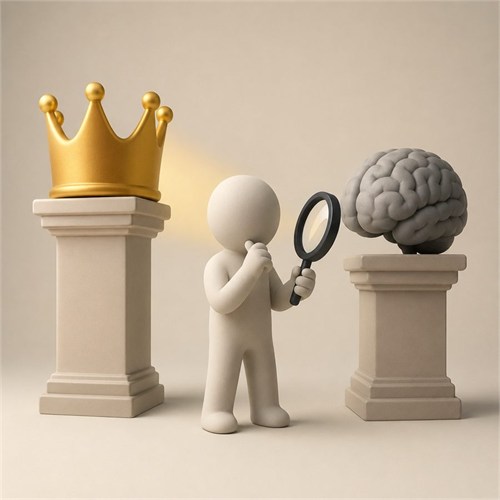
- Respect authority, but verify the evidence. A crown may guide attention, but it should not replace thinking.
