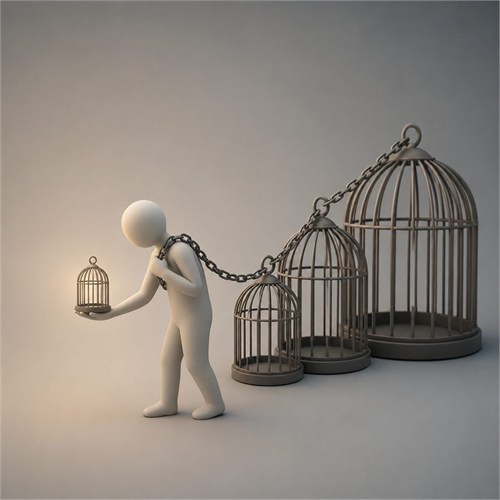
Birdcage Effect
Be careful what “empty birdcages” you bring into your life: small unnecessary things can quietly create pressure for larger unnecessary commitments.
Definition
- The Birdcage Effect refers to the tendency for a person who acquires an unnecessary object to later acquire related objects, habits, or behaviors in order to make the original object seem useful, complete, or socially explainable.
Core Idea
- An initial object, cue, or commitment can create psychological pressure to “complete the set.”
- The classic form is: once someone owns a birdcage, they may feel pushed to get a bird.
How It Works
- A person receives or buys something they did not originally need.
- The object creates a visible gap or inconsistency.
- The person feels pressure from habit, social questions, self-justification, or perceived incompleteness.
- To reduce that pressure, the person adds related things or changes behavior.
- In marketing, a small initial item can lead to follow-up purchases.
Usage Example
- Someone buys an expensive camera but rarely takes photos.
- Later, they buy lenses, a camera bag, editing software, and photography courses because the original camera makes them feel they “should” become a photography person.
Famous Example
-
Example:
-
A commonly repeated story says William James gave his friend Carlson a birdcage. Visitors kept asking why the cage had no bird, so Carlson eventually bought a bird.
-
Why it fits this rule:
-
The birdcage created social and psychological pressure to obtain the matching item: a bird.
Use Cases / Situations Where It Applies
- Buying accessories after buying a core product.
- Starting a habit by placing a visible cue in the environment.
- Marketing funnels that begin with a free sample, trial, gift, or starter item.
- Workplace tools that create pressure to adopt related workflows.
- Personal productivity, such as leaving a book open to encourage reading.
When Not to Use or Common Misuse
- Do not treat it as a formally established academic law unless reliable research is cited.
- Do not use it to explain every follow-up purchase; sometimes people buy related items because they genuinely need them.
- Do not confuse it with sunk cost fallacy, where people continue because of past investment.
- Do not confuse it with foot-in-the-door technique, where a small request increases compliance with a larger request.
- Do not present the William James story as verified fact.
Rule Invention / Origin
-
Invented by:
-
Unknown.
-
Year of invention:
-
Unknown. Some popular sources claim 1907, but this date appears tied to the unverified William James story.
-
Country / context of origin:
-
Unclear. The term is common in Chinese popular psychology writing, but a verified academic origin was not found.
-
William James was a real American psychologist and philosopher, and Stanford Encyclopedia of Philosophy records that he resigned his Harvard professorship in 1907. This supports only the biographical timing, not the birdcage story itself.
Short Practical Takeaway
- Be careful what “empty birdcages” you bring into your life: small unnecessary things can quietly create pressure for larger unnecessary commitments.
