Philosophy / Decision-Making / Psychology
Philosophy / Decision-Making / PsychologyBuridan's Ass
When two options appear equally attractive, the search for the "correct" choice can paralyze action.
Popularity
Usefulness
Aliases
Buridan's donkey / Buridan's principle / paradox of indecision
Domains
Philosophy, decision theory, behavioral psychology, management
Definition
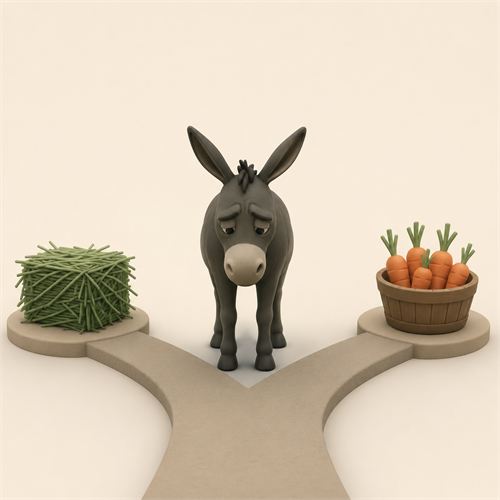
- Buridan's Ass is a thought experiment about a perfectly rational donkey placed exactly between two identical bales of hay that, unable to choose between equally good options, starves to death — illustrating how indecision between equal choices can be worse than either choice itself.
Core Idea
- When two options appear equally attractive, the search for the "correct" choice can paralyze action.
- The cost of not deciding often exceeds any difference between the options.
- Choosing something and moving is usually better than optimizing forever between near-equals.
How It Works
- Facing equal alternatives, a strictly "rational" actor has no tiebreaker and stalls.
- Real harm comes not from picking the wrong bale but from picking neither.
- Adding any small tiebreaker — a deadline, a coin flip, a default — breaks the deadlock.
Usage Example
- A buyer cannot decide between two similar apartments of equal merit and keeps postponing; while deliberating, both are taken by others. The delay, not the choice, caused the loss.
Famous Example
- Example: The paradox is named after 14th-century French philosopher Jean Buridan, who discussed moral determinism, though the starving-donkey illustration was used by critics to mock his view.
- Why it fits this rule: It dramatizes how demanding a decisive reason before acting can produce fatal inaction.
Use Cases / Situations Where It Applies
- Recognizing decision paralysis when options are genuinely close.
- Designing defaults and deadlines to prevent stalling.
- Knowing when to stop gathering information and commit.
When Not to Use or Common Misuse
- Do not use it to justify reckless snap decisions when options genuinely differ and analysis matters.
- Do not treat every hard choice as a Buridan situation; sometimes more information truly changes the answer.
- Do not ignore that some delays are strategically valuable.
Rule Invention / Origin
- Invented by: Named after Jean Buridan (c. 1300–1361); the underlying idea predates him (Aristotle, al-Ghazali).
- Year of invention: 14th century (concept); ancient roots.
- Country / context of origin: Medieval European philosophy.
Evidence / Research Basis
- The scenario is a philosophical illustration rather than an empirical law, but it maps onto well-documented modern findings on choice overload and decision paralysis.
