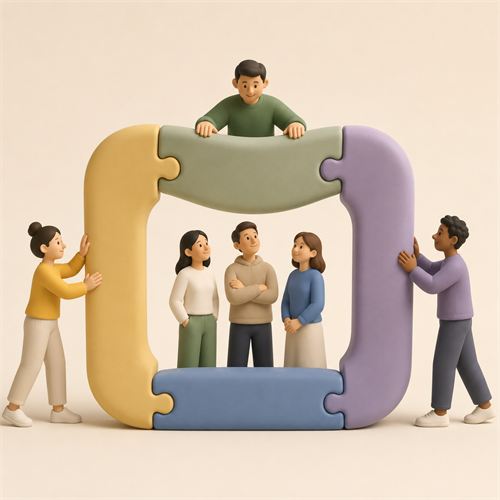
Management / Leadership / Organizational Behavior
Management / Leadership / Organizational BehaviorFlexible Management Rules
Manage people through influence and motivation, not just rigid control.
Popularity
Usefulness
Aliases
Soft management / humanized management / people-centered management
Domains
Management, leadership, organizational behavior, culture
Definition
- Flexible Management Rules describe a people-centered, humanized approach that adapts to people through trust and motivation rather than forcing people to fit rigid rules.
Core Idea
- Manage people through influence and motivation, not just rigid control.
- Adapt to people's needs rather than forcing rigid conformity.
- "Soft" management complements, and sometimes outperforms, "hard" rules.
How It Works
- Instead of relying solely on rules and authority, leaders use trust, culture, and motivation.
- People are guided by shared values and internal commitment.
- The approach flexes to individuals and situations.
Usage Example
- A company that motivates through purpose, autonomy, and recognition — rather than rigid rules alone — often gets more committed effort, especially from knowledge workers.
Famous Example
- Example: The "soft/flexible management" movement emphasizing humanized, people-centered management.
- Why it fits this rule: It centers adaptable, people-first management over rigid control.
Use Cases / Situations Where It Applies
- Managing knowledge workers and creatives.
- Building values-driven cultures.
- Complementing rules with motivation.
When Not to Use or Common Misuse
- Do not abandon necessary structure and accountability.
- Do not use "flexibility" as an excuse for inconsistency.
- Do not assume soft management suits every context.
Rule Invention / Origin
- Invented by: A management movement; no single author.
- Year of invention: Modern.
- Country / context of origin: Management literature.
Evidence / Research Basis
- Consistent with research on intrinsic motivation, culture, and human-centered management.
