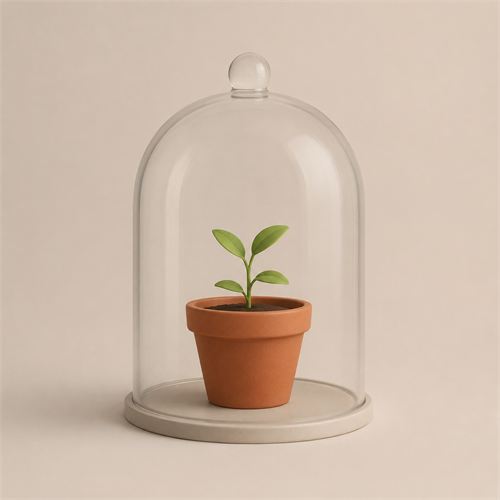
Management / Development / Environment
Management / Development / EnvironmentFlower Pot Effect
A too-comfortable environment limits real growth.
Popularity
Usefulness
Aliases
Flowerpot effect / local-habitat effect / greenhouse effect (of comfort)
Domains
Management, talent development, education, environment
Definition
- The Flower Pot Effect (also called the local-habitat effect) describes how a sheltered, comfortable environment — like a flowerpot — fosters short-term growth but breeds dependence and fragility, leaving people unable to thrive once removed from it.
Core Idea
- A too-comfortable environment limits real growth.
- Sheltered conditions breed dependence and fragility.
- Genuine resilience develops only through exposure to real conditions.
How It Works
- A flowerpot provides controlled, easy conditions — but confined ones.
- Plants (and people) grown only in such shelter develop shallow roots and weak adaptability.
- Removed from the pot into harsher reality, they struggle or fail.
Usage Example
- An employee coddled in an over-protected role looks capable there but flounders when moved to a demanding environment, having never built real adaptability.
Famous Example
- Example: The flowerpot as a metaphor for sheltered "local habitat" conditions in education and management.
- Why it fits this rule: It captures comfort breeding dependence and fragility.
Use Cases / Situations Where It Applies
- Talent development and training.
- Education and learning environments.
- Building resilience and adaptability.
When Not to Use or Common Misuse
- Do not swing to the opposite extreme of harsh, unsupportive conditions.
- Do not remove all support; growth needs challenge balanced with support.
- Do not assume comfort is always harmful — recovery and stability matter too.
Rule Invention / Origin
- Invented by: No single attributed author; an education/management metaphor.
- Year of invention: Modern.
- Country / context of origin: Popular management and education literature.
Evidence / Research Basis
- Consistent with research on challenge, stretch experiences, and resilience.
