Management metaphor; teamwork principle
Management metaphor; teamwork principleFlying Geese Effect
As a management metaphor, the Flying Geese Effect says coordinated groups go farther when direction is shared and the hardest role can rotate. Do not confuse it with the separate Flying Geese Paradigm in development economics.
Popularity
Usefulness
Aliases
Geese Formation Effect / V-Formation Effect / Flying Geese Principle
Domains
Management, leadership, organizational behavior, teamwork, animal flight behavior
Definition
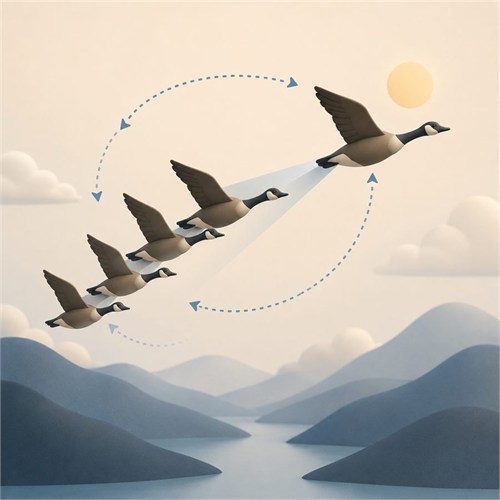
- The Flying Geese Effect is a management metaphor drawn from geese flying in formation. It explains how coordinated members can reduce individual burden, maintain direction, support one another, and rotate demanding roles.
- It should be distinguished from the separate Flying Geese Paradigm in development economics, which describes staged industrial upgrading across countries.
Core Idea
- A group can move farther and more efficiently when members align around a common direction, support one another, and rotate demanding roles instead of leaving all pressure on one leader.
How It Works
- Geese often fly in V-shaped formations during migration.
- The formation can reduce wind resistance for birds flying behind the leader and helps the flock conserve energy.
- The front bird works harder because it receives less aerodynamic benefit, so the lead position may rotate.
- In management usage, this becomes a lesson about shared leadership, coordination, mutual support, and alignment between individual effort and group goals.
- If the topic is regional industrial development rather than teamwork, the more accurate term is Flying Geese Paradigm, not Flying Geese Effect.
Usage Example
- A project team has one senior engineer leading the first phase. As the workload grows, other engineers take turns leading modules, reviewing code, and supporting weaker areas. The team stays aligned and avoids burning out one person. This is an organizational use of the Flying Geese Effect.
Famous Example
- Example: Migrating geese flying in V formation, with birds benefiting from formation flight and the lead position changing over time.
- Why it fits this rule: The management metaphor comes directly from this formation behavior: shared direction, mutual support, and rotation of the hardest position.
Use Cases / Situations Where It Applies
- Teamwork requiring coordination and shared direction.
- Leadership rotation to prevent burnout.
- Cross-functional teams where each member supports the whole system.
- Organizations trying to align departmental goals with company-wide goals.
- Explaining why coordinated groups can outperform isolated individuals.
When Not to Use or Common Misuse
- Do not treat it as a proven universal management law.
- Do not assume every team naturally works like a goose formation; human incentives, conflict, skill gaps, and power structures matter.
- Do not overstate claims such as "teams become 70% more efficient" unless a reliable source is provided; this number is common in motivational writing but is not consistently verified.
- Do not confuse the informal teamwork metaphor with Akamatsu's formal economic Flying Geese Paradigm.
- If you are discussing East Asian industrial upgrading, trade, or production relocation, use the economic term directly instead of this management metaphor.
Rule Invention / Origin
- Invented by: Unknown for the general teamwork or management metaphor.
- Year of invention: Unknown for the management metaphor.
- Country / context of origin: The teamwork metaphor appears in later management writing based on observed bird flight behavior. The separate economic Flying Geese Paradigm originated in Japan through Kaname Akamatsu's work on industrial development and catching-up economies in the 1930s.
Short Practical Takeaway
- A strong team does not only need a strong leader; it needs shared direction, coordinated positioning, mutual support, and the wisdom to rotate the hardest roles before anyone falls out of formation.
