Management / Development / Competition
Management / Development / CompetitionForest Effect
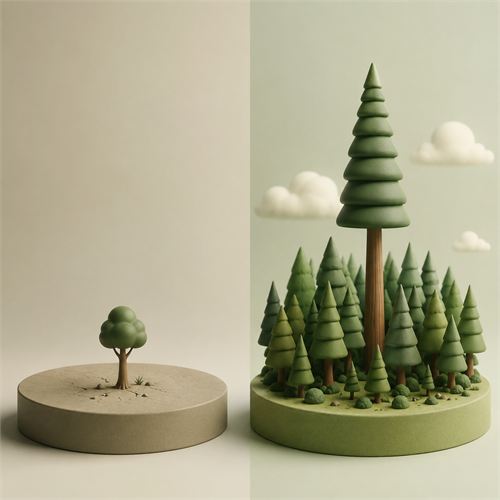
A tree alone in the open stays short and misshapen; in a forest it grows tall.
Popularity
Usefulness
Aliases
Forest principle / grow-among-peers effect
Domains
Management, talent development, competition, environment
Definition
- The Forest Effect holds that, like a tree that grows tall and strong only among other trees, people and organizations develop best within a competitive, stimulating environment rather than in isolation.
Core Idea
- A tree alone in the open stays short and misshapen; in a forest it grows tall.
- Competition among peers drives upward growth.
- The right environment shapes development as much as innate potential.
How It Works
- In a forest, trees compete for sunlight and water, pushing each other to grow taller and fuller.
- People and firms surrounded by capable peers are likewise pushed to improve.
- Isolation removes that stimulus, leaving potential unrealized.
Usage Example
- A talented employee placed among ambitious, high-performing peers raises their own game, where the same person in an unchallenging setting would coast.
Famous Example
- Example: The contrast between a lone tree in open ground and trees in a dense forest.
- Why it fits this rule: It shows competitive environment driving stronger growth.
Use Cases / Situations Where It Applies
- Talent development and team composition.
- Creating stimulating, competitive cultures.
- Clustering and ecosystem effects.
When Not to Use or Common Misuse
- Do not let competition become destructive rather than developmental.
- Do not assume every individual thrives best under intense rivalry.
- Do not neglect support and resources alongside competition.
Rule Invention / Origin
- Invented by: No single author; a nature-derived management metaphor.
- Year of invention: Modern.
- Country / context of origin: Popular management literature.
Evidence / Research Basis
- Consistent with research on peer effects, environment, and clustering.
