Psychology / Motivation / Goal-Setting
Psychology / Motivation / Goal-SettingHalfway Effect
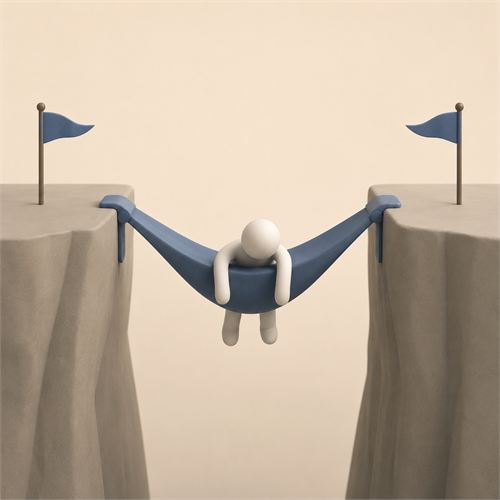
Midpoints can feel psychologically heavy.
Popularity
Usefulness
Aliases
Midpoint slump / halfway-point demotivation
Domains
Psychology, motivation, goal pursuit, project management
Definition
- Halfway Effect is a real label in some management and psychology-adjacent writing, though it is not a universally standardized classic effect name. It describes the tendency for motivation and persistence to sag around the midpoint of a long task or goal.
Core Idea
- Midpoints can feel psychologically heavy.
- People often need structure most in the middle, not at the start.
- Use the standard name and meaning to avoid confusion.
How It Works
- Attention, comparison, tension, or gradual change can distort judgment or motivation.
- The label often survives because the pattern is memorable and teachable.
- Evidence is uneven, so the effect should be used carefully.
Usage Example
- A learner stays energized at the start of a program, drifts in the middle, and needs smaller milestones to recover momentum.
Famous Example
- Example: Modern motivation research also documents midpoint dips and changes in effort around halfway markers.
- Why it fits this rule: The midpoint matters because novelty is gone while the finish still feels far away.
Use Cases / Situations Where It Applies
- Explaining behavior in plain language.
- Teaching with memorable metaphors.
- Recognizing recurring cognitive or motivational patterns.
When Not to Use or Common Misuse
- Do not overclaim the evidence.
- Do not confuse metaphor with literal biology or experiment.
- Do not assume the effect is equally strong for everyone.
Rule Invention / Origin
- Invented by: No single canonical discoverer for the label.
- Year of invention: Modern usage; midpoint effects are studied across goal and consumer research.
- Country / context of origin: Management writing and adjacent behavioral research.
Evidence / Research Basis
- Behavioral research supports midpoint changes in motivation and effort, even though the exact label is less standardized than the pattern.
