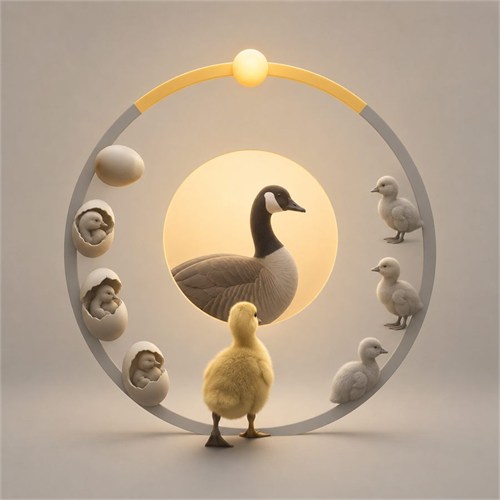
Learning effect / developmental behavior
Learning effect / developmental behaviorImprinting Effect
Early exposure can matter greatly when it happens during the right developmental window, but “imprinting” should be used precisely: it is a specific biological learning phenomenon, not just any strong first impression.
Popularity
Usefulness
Aliases
Imprinting Effect / Filial Imprinting / Prägung / Social Imprinting / Sexual Imprinting
Domains
Ethology, animal behavior, developmental psychology, psychobiology, attachment research
Definition
- Imprinting is a specialized form of early learning in which a young animal forms a strong and often lasting preference or attachment to a particular object, individual, or class of stimuli during a limited sensitive period early in life. It is best established in precocial birds such as ducks, chicks, and geese.
Core Idea
- Early experience can have an unusually strong effect when it occurs during a biologically prepared sensitive period.
- In classic filial imprinting, a young bird may learn to follow the first suitable moving object it encounters soon after hatching.
- The effect is not simply ordinary habit formation; it depends on species, timing, stimulus type, and developmental readiness.
How It Works
- The organism is born with a readiness to attend to certain stimuli, such as movement, sound, shape, or parental cues.
- During a sensitive or critical period, exposure to a suitable stimulus can create a strong social preference.
- After the sensitive period closes, the same exposure may have much weaker effects.
- In many simplified accounts, imprinting is described as irreversible, but modern research treats it more carefully: some imprinted preferences can be strong and persistent, yet learning, context, and later experience may still matter.
Usage Example
- A newly hatched duckling raised in an incubator may follow a human caretaker or moving object if that is the first salient moving stimulus it encounters during the sensitive period.
- In human settings, the term should usually be used metaphorically or cautiously, for example: “A child’s early environment can strongly shape later expectations,” rather than claiming humans imprint exactly like goslings.
Famous Example
- Example: Konrad Lorenz’s demonstrations with young geese and ducklings, in which hatchlings followed him after early exposure.
- Why it fits this rule: The birds formed a strong following response toward a non-parental figure during a short early-life window, illustrating filial imprinting.
Use Cases / Situations Where It Applies
- Studying early parent-offspring attachment in birds and some other animals.
- Understanding sensitive periods in development.
- Animal husbandry, wildlife rehabilitation, and conservation breeding, where accidental human imprinting can cause later behavioral problems.
- Explaining why early exposure can shape later social or mate preferences in some species.
- As a cautious analogy for early-life learning in humans, but not as a direct one-to-one model.
When Not to Use or Common Misuse
- Do not use it to mean any strong first impression.
- Do not use it as a general synonym for habit, branding, nostalgia, or childhood memory.
- Do not claim that human attachment is identical to duckling or gosling imprinting.
- Do not say Lorenz invented or discovered imprinting without qualification.
- Do not assume imprinting happens in all animals; it is most clearly demonstrated in specific species and contexts.
- Do not describe it as always permanent or completely irreversible.
Rule Invention / Origin
- Invented by: Unclear if “invented” means first observed, named, or popularized. Douglas Spalding reported related early observations in the 1870s; Oskar Heinroth used the German term “Prägung”; Konrad Lorenz extensively studied and popularized imprinting in the 1930s.
- Year of invention: No single agreed year. Important dates include 1873 for Spalding’s early work and 1935 for Lorenz’s influential “Kumpan” paper.
- Country / context of origin: Early animal-behavior research in Britain and German-speaking Europe; later developed within ethology, especially through Lorenz’s work in Austria/German-speaking scientific circles.
Short Practical Takeaway
- Early exposure can matter greatly when it happens during the right developmental window, but “imprinting” should be used precisely: it is a specific biological learning phenomenon, not just any strong first impression.
