Management / Systems / Engineering
Management / Systems / EngineeringMiG-25 effect
Integration and coordination create capability beyond individual parts.
Popularity
Usefulness
Aliases
System-integration effect / whole-greater-than-parts principle
Domains
Systems thinking, management, engineering, team design
Definition
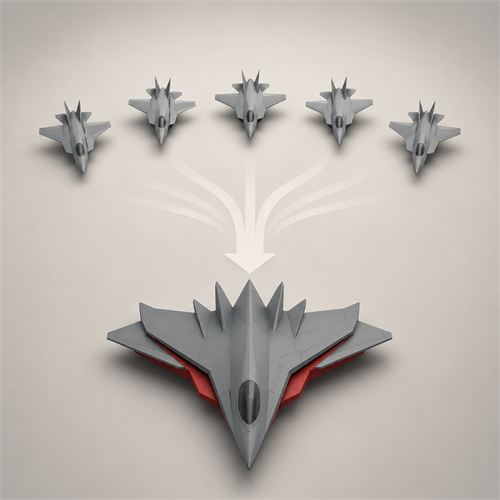
- The MiG-25 effect is the principle that a well-integrated whole can outperform the sum of its individually average parts — overall capability depends on how components work together, not just on each component's quality.
Core Idea
- Integration and coordination create capability beyond individual parts.
- Average components, optimally combined, can beat superior but poorly coordinated ones.
- The system's design matters as much as the quality of its pieces.
How It Works
- Each component is chosen and tuned to serve the whole.
- Coordination eliminates weak links and exploits synergies.
- The integrated system delivers performance no single part could.
Usage Example
- A team of solid-but-not-star players who coordinate brilliantly outperforms a collection of individual stars who do not work together.
Famous Example
- Example: The Soviet MiG-25 fighter, reportedly built from components that were not all cutting-edge, yet achieved outstanding overall performance through integration.
- Why it fits this rule: System design, not just part quality, drove its capability.
Use Cases / Situations Where It Applies
- Team and system design.
- Optimizing integration and coordination.
- Valuing fit over individual brilliance.
When Not to Use or Common Misuse
- Do not use it to excuse genuinely weak components where quality is essential.
- Do not neglect that some systems need top-tier parts.
- Do not assume integration compensates for any deficiency.
Rule Invention / Origin
- Invented by: Popular management framing of a military-engineering example.
- Year of invention: Modern.
- Country / context of origin: Popular management literature.
Evidence / Research Basis
- Aligns with systems theory and research on team coordination and synergy.
