Psychology / Medicine / Behavioral Science
Psychology / Medicine / Behavioral SciencePlacebo Effect
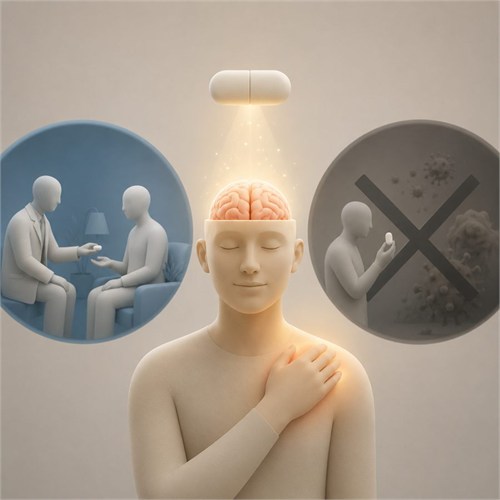
Expectations, ritual, and care context can change how people feel, especially with symptoms such as pain. That improvement is real, but it does not prove an inactive treatment cures the underlying illness.
Popularity
Usefulness
Aliases
Placebo response / placebo analgesia / nonspecific treatment effect / expectancy effect
Domains
Clinical medicine, psychology, neuroscience, pharmacology, clinical trials, pain research
Definition
- The placebo effect happens when improvement follows expectation, context, or treatment ritual rather than a specific active ingredient in the treatment itself.
Core Idea
- A person’s mind, expectations, prior experience, and treatment environment can influence real symptoms and perceived improvement.
- It does not mean “fake illness” or “imaginary symptoms”; placebo responses can involve measurable brain and body mechanisms.
How It Works
- Positive expectation: the patient believes the treatment may help.
- Conditioning: past experience with real treatment can make the body respond to a similar-looking treatment.
- Doctor-patient interaction: trust, reassurance, ritual, and care context can influence symptom perception.
- Neurobiological mechanisms: placebo analgesia has been linked to brain systems involving endogenous opioids and other pain-modulating pathways.
Usage Example
- In a clinical trial, one group receives a real drug and another group receives an inactive pill that looks the same. If both groups improve, researchers compare the results to determine how much improvement is due to the drug itself and how much may be due to placebo response, chance, natural recovery, or other factors.
Famous Example
- Example: Henry K. Beecher’s 1955 paper “The Powerful Placebo”.
- Why it fits this rule: Beecher argued that placebo responses were clinically important and helped popularize the idea that placebo effects must be controlled for in medical research.
Use Cases / Situations Where It Applies
- Clinical trials and drug testing.
- Pain relief and symptom perception.
- Stress-related symptoms, fatigue, nausea, and subjective symptom reporting.
- Understanding how expectation, trust, and treatment ritual influence outcomes.
- Designing ethical, non-deceptive patient communication.
When Not to Use or Common Misuse
- Do not use it to claim that serious diseases can be cured by belief alone.
- Do not use it as proof that a treatment works better than standard medical care.
- Do not confuse symptom improvement with disease reversal.
- Do not use deceptive placebo treatment casually; deception raises ethical problems.
- Do not assume every improvement after treatment is a placebo effect; natural recovery, regression to the mean, measurement error, and real treatment effects may also explain improvement.
Rule Invention / Origin
- Invented by: No single inventor. The concept developed gradually in medicine.
- Year of invention: Unclear. The medical use of the word “placebo” appears in the 18th century; Scottish physician William Cullen used the phrase “pure placebo” in 1772.
- Country / context of origin: Early documented medical usage is associated with Britain/Scotland in 18th-century clinical medicine. Scientific study of placebo effects became especially important in 20th-century clinical trials.
Short Practical Takeaway
- Expectations and treatment context can change how people feel and respond, especially for symptoms like pain, but placebo effects should not be mistaken for proof that an inactive treatment cures disease.
