Management / Social Psychology / Teams
Management / Social Psychology / TeamsRingelmann Effect
"One person is dedicated, two pass the buck, three never get it done."
Popularity
Usefulness
Aliases
Washington's cooperation law / social loafing in groups / "1+1<2" effect
Domains
Organizational behavior, teamwork, social psychology, productivity
Definition
- The Ringelmann Effect is the tendency for individual effort to decline as group size increases, so adding people yields less than proportional output.
Core Idea
- "One person is dedicated, two pass the buck, three never get it done."
- As teams grow, per-person contribution often shrinks.
- More hands do not always mean proportionally more pulling.
How It Works
- In larger groups, individual contribution becomes less visible and accountable.
- Coordination losses and motivation losses accumulate.
- Total output rises more slowly than headcount, and per-person output falls.
Usage Example
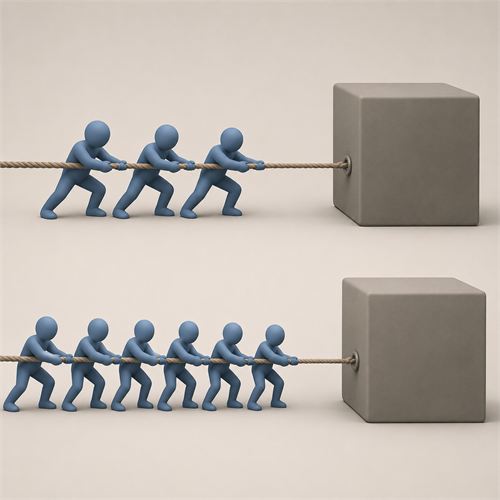
- A rope-pulling team of eight does not pull eight times as hard as one person; each member, feeling less individually responsible, eases off.
Famous Example
- Example: Max Ringelmann's rope-pulling experiments measuring declining per-person force as group size grew.
- Why it fits this rule: Average individual effort dropped with each added puller.
Use Cases / Situations Where It Applies
- Sizing teams to avoid diluted accountability.
- Designing visible individual contributions.
- Diagnosing why a bigger team underperforms.
When Not to Use or Common Misuse
- Do not conclude that small teams are always better for every task.
- Do not ignore tasks that genuinely require many people.
- Do not blame individuals without fixing structure and accountability.
Rule Invention / Origin
- Invented by: Maximilien Ringelmann.
- Year of invention: Studies published around 1913 (work from the 1880s–1910s).
- Country / context of origin: France, agricultural engineering.
Evidence / Research Basis
- The effect anticipated modern social-loafing research, which robustly confirms motivation and coordination losses in groups.
