Psychology experiment / cognitive psychology concept
Psychology experiment / cognitive psychology conceptSensory Deprivation Experiment
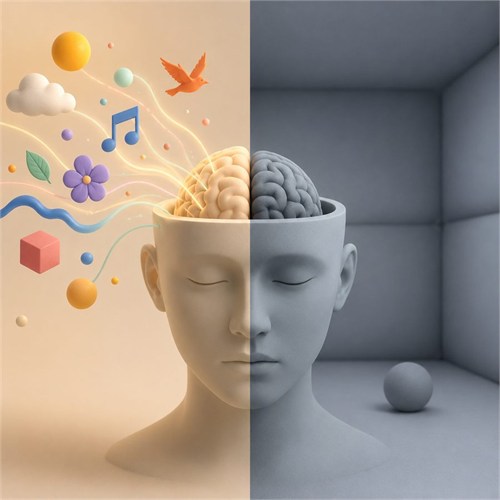
The brain does not thrive on flat, unchanging input. When sensory variety drops too far, attention, mood, and perception can become unstable.
Popularity
Usefulness
Aliases
Perceptual Isolation Experiment / Sensory Deprivation / Reduced Sensory Input Experiment / Restricted Environmental Stimulation / REST
Domains
Experimental psychology / cognitive psychology / perception / attention / consciousness studies / human factors / clinical psychology
Definition
- A sensory deprivation experiment is a controlled study in which normal sensory input is deliberately reduced or made monotonous, usually to study how reduced stimulation affects attention, perception, thinking, emotion, and consciousness.
Core Idea
- Human mental functioning depends not only on receiving information, but also on receiving enough varied sensory input.
- When sensory input becomes very limited or monotonous, people may experience boredom, restlessness, difficulty concentrating, distorted perception, vivid imagery, or hallucination-like experiences.
- The effect is not always caused by sensory reduction alone; later research warned that participants’ expectations and experimental cues can also shape the reported effects.
How It Works
- In the landmark McGill-style setup, participants were paid to lie on a bed in a cubicle for long periods while sensory variety was reduced.
- Visual input was limited with translucent goggles; touch was reduced with gloves and cardboard cuffs; sound was reduced by a partly soundproof room, masking noise, and a foam-rubber pillow.
- Communication with experimenters was kept minimal.
- The setup reduced sensory variation but did not create complete sensory absence.
Usage Example
- A researcher wants to study why a radar operator, security guard, or pilot may lose attention during long periods of monotonous monitoring.
- Instead of adding distraction, the researcher reduces novelty and sensory variation to see whether sustained attention and thinking deteriorate.
Famous Example
- Example: Early McGill perceptual-isolation studies placed volunteers in an environment with very little varied sensory input and tracked how their concentration, mood, and perception changed over time.
- Why it fits this rule: The experiments were designed to see what happens when the mind receives far less stimulation than usual.
Use Cases / Situations Where It Applies
- Studying attention loss in monotonous work environments.
- Understanding boredom, vigilance failure, and reduced stimulation.
- Exploring altered perception, mental imagery, and hallucination-like experiences.
- Comparing environmental effects with expectation effects in psychology experiments.
- Discussing ethical limits in human-subject experiments.
When Not to Use or Common Misuse
- Do not treat it as proof that “people go insane after 48 hours”; that is an exaggerated popular version.
- Do not confuse sensory deprivation with ordinary solitude, meditation, boredom, sleep deprivation, or solitary confinement.
- Do not assume every reported hallucination is caused purely by sensory reduction; participant expectations and demand characteristics can contribute.
- Do not use the concept to justify coercive isolation or interrogation practices.
Rule Invention / Origin
- Invented by: Not clearly “invented” by one person. A landmark early human sensory deprivation study was conducted at McGill University by W. H. Bexton, W. Heron, and Scott, associated with Donald O. Hebb’s research environment.
- Year of invention: Unclear as a general idea; the landmark McGill publication appeared in 1954, with later summaries describing the first McGill studies as beginning around 1951.
- Country / context of origin: Canada; McGill University. The context included interest in attention lapses under monotonous conditions, such as radar watching and other vigilance tasks.
Short Practical Takeaway
- The mind needs a steady flow of varied input to stay organized and alert; when input becomes too limited or monotonous, attention, perception, and thinking can become unstable.
