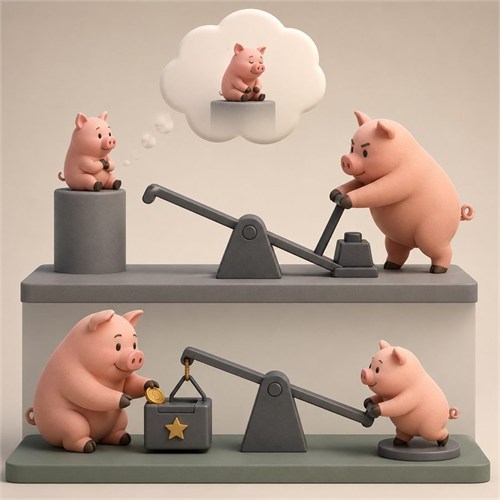
Game theory; asymmetric game; Nash equilibrium example
Game theory; asymmetric game; Nash equilibrium exampleSmart Pig Game Theory
If one player must act for the game to move at all, the weaker player may do better by waiting than by competing head-on. The stronger player then has to think about incentives, not just force.
Popularity
Usefulness
Aliases
Smart Pig Game / Rational Pigs / Boxed-Pigs Game / Pig Game
Domains
Economics / management strategy / organizational incentives / evolutionary game theory / business competition
Definition
- The Boxed Pigs Game is an asymmetric two-player game in which a strong player and a weak player choose whether to pay a cost to create a shared benefit. In the standard model, the weak player’s best strategy is to wait, while the strong player ends up paying the cost.
Core Idea
- A weaker player can sometimes gain advantage by not acting first, because the stronger player has more incentive or capacity to bear the cost. This makes “waiting” rational for the weak player and “acting” rational for the strong player.
How It Works
- Two pigs are placed in a box: one large/dominant pig and one small/subordinate pig.
- A lever or panel at one end releases food at the other end, but pressing it has a cost.
- If the small pig presses, the big pig can reach or dominate the food, leaving little benefit for the small pig.
- If the big pig presses while the small pig waits near the food, both receive some benefit.
- In Eric Rasmusen’s textbook version, the unique Nash equilibrium is: Big Pig presses; Small Pig waits.
Usage Example
- A small company may avoid spending heavily to educate a new market. Instead, it waits for a large company to invest in marketing, infrastructure, or customer education, then enters later with a cheaper imitation or niche product. Rasmusen gives a similar business analogy: if a large firm pays to introduce a new product category, a smaller firm may imitate profitably without fully destroying the large firm’s sales.
Famous Example
- Example: In the boxed-pigs teaching model, a large pig can press a lever that releases food far from the switch, while a smaller pig can wait by the trough and eat first.
- Why it fits this rule: The smaller pig can benefit by letting the larger pig bear the cost of action, which changes the larger pig's best response.
Use Cases / Situations Where It Applies
- Small firms waiting for large firms to build or educate a market.
- Free-rider problems where one party benefits from another party’s costly action.
- Public-goods situations where one player has stronger incentives to contribute.
- Organizational settings where strong performers carry shared work while weaker or lower-power members wait.
- Strategic timing decisions: act first, wait, imitate, or let another party bear the setup cost.
When Not to Use or Common Misuse
- Do not use it when players are roughly equal in power, cost, speed, or access to benefits.
- Do not confuse it with the Prisoner’s Dilemma; the Boxed Pigs Game is asymmetric and does not have the same “both defect” structure.
- Do not assume “waiting” is always smart; it works only when the stronger player still has enough incentive to act.
- Do not claim John Nash personally invented the Smart Pig Game unless a reliable primary source is found. The sources checked support “Boxed Pigs” as a game-theory example based on Baldwin and Meese’s 1979 pig experiment, not as a clearly documented invention by Nash.
Rule Invention / Origin
- Invented by: Unknown as a named “Smart Pig Game Theory.” The underlying experiment is attributed to B. A. Baldwin and G. B. Meese.
- Year of invention: No verified single invention year. The underlying pig experiment was published in 1979; later game-theory texts use it as the “Boxed Pigs” example.
- Country / context of origin: Animal behavior and operant-conditioning research; later adapted into economics/game-theory teaching.
Short Practical Takeaway
- When you are the weaker player, it may be rational to wait if the stronger player must act anyway; when you are the stronger player, design incentives carefully so you are not always the one pressing the lever.
