Social psychology / aggression / priming effect
Social psychology / aggression / priming effectWeapon Effect
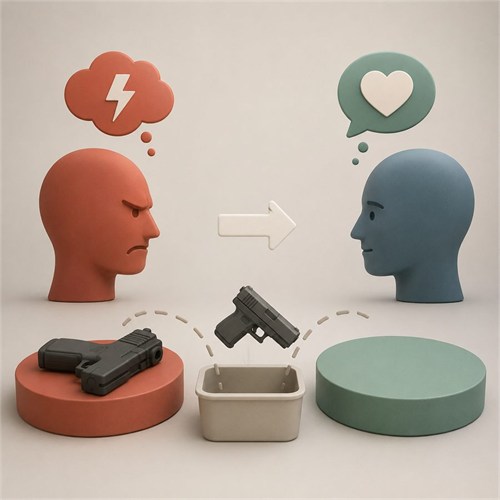
In an already heated situation, violent cues can push the mind closer to aggression. Removing the cue can matter before any argument is resolved.
Popularity
Usefulness
Aliases
Weapon Effect / weapons priming effect / aggression-eliciting weapon cue
Domains
Social psychology, behavioral science, criminology, violence prevention, media-effects research, safety design
Definition
- The weapons effect is the tendency for the presence of a weapon to prime hostile thoughts, interpretations, or aggressive responses, especially when a person is already angry or provoked.
Core Idea
- A weapon is not only a tool for violence; it can also function as a situational cue that makes aggressive ideas more mentally available.
- The effect is probabilistic, not deterministic: seeing a weapon may raise aggression-related responses, but it does not mean a person will automatically become violent.
How It Works
- Weapons are strongly associated with harm, threat, and violence.
- When a weapon is visible, it may prime aggression-related thoughts or scripts.
- In a tense or provocative situation, those activated thoughts may make aggressive responses feel more available or appropriate.
- Later research suggests the effect is shaped by context, provocation, prior experience with weapons, cultural meaning, and publication-bias concerns in the research literature.
Usage Example
- In a heated argument, leaving a knife, firearm, or other weapon-like object visibly nearby may increase the salience of aggressive options. A practical response is to remove visible weapons or aggressive cues from the environment before trying to de-escalate the conflict.
Famous Example
- Example: In Berkowitz and LePage's well-known laboratory study, provoked participants showed stronger aggressive responding when guns were present than when neutral objects were nearby.
- Why it fits this rule: The weapon acted as a cue that made aggression more psychologically available.
Use Cases / Situations Where It Applies
- Conflict de-escalation: remove visible weapons or weapon-like cues during disputes.
- Home and workplace safety: avoid displaying threatening objects in emotionally charged settings.
- Media and game analysis: examine whether weapon imagery primes aggressive thoughts.
- Law enforcement and security training: understand how visible weapons may alter perception and behavior.
- Experimental psychology: study how environmental cues influence aggression.
When Not to Use or Common Misuse
- Do not use it to claim that weapons automatically cause violence.
- Do not confuse it with the weapon-focus effect, which concerns eyewitness attention and memory when a weapon is present.
- Do not treat it as proof that any specific violent act was caused by seeing a weapon.
- Do not ignore context: provocation, personality, norms, training, weapon familiarity, and situational meaning can all change the effect.
- Do not overstate the evidence; meta-analytic findings support some weapons-effect outcomes but also warn that published literature may overestimate some effects.
Rule Invention / Origin
- Invented by: Not literally “invented.” The phenomenon is generally credited to social psychologists Leonard Berkowitz and Anthony LePage, who reported the classic 1967 study “Weapons as Aggression-Eliciting Stimuli.”
- Year of invention: 1967
- Country / context of origin: United States; laboratory social-psychology research at the University of Wisconsin.
Short Practical Takeaway
- In tense situations, visible weapons can make aggression more psychologically available. Reduce aggressive cues first; then talk.
