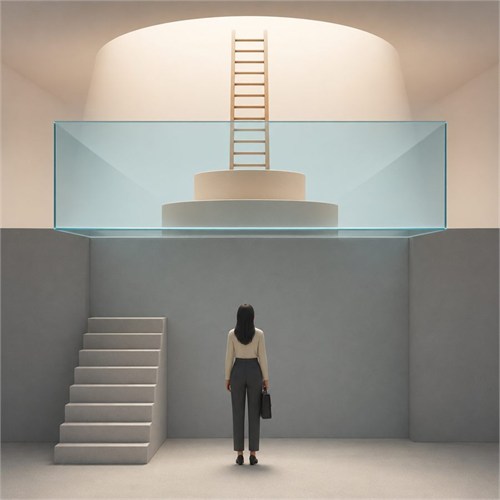
Glass Ceiling Effect illustration
Social inequality / organizational behavior / workplace discrimination

Glass Ceiling Effect

The Glass Ceiling Effect means that formal access is not the same as real opportunity: a person may be qualified and allowed to compete, yet still be blocked by hidden structural or cultural barriers.

Popularity
Usefulness
Aliases
Glass ceiling / glass ceiling phenomenon / invisible barrier to advancement
Domains
Management, sociology, gender studies, diversity and inclusion, labor economics, organizational psychology

Definition

  • The Glass Ceiling Effect refers to an invisible but persistent barrier that prevents qualified people, especially women and minority groups, from advancing to senior leadership or top-level positions despite having the ability, qualifications, or achievements required. Merriam-Webster defines “glass ceiling” as an intangible barrier within a hierarchy that prevents women or minorities from obtaining upper-level positions. (merriam-webster.com)

Core Idea

  • The barrier is called “glass” because people can often see higher positions and may formally be eligible for them, but informal, cultural, structural, or discriminatory forces make those positions difficult to reach.
  • It is called a “ceiling” because it limits upward movement beyond a certain organizational level.
  • The concept focuses on hidden or indirect barriers, not only explicit legal exclusion.

How It Works

  • Bias in promotion decisions, leadership stereotypes, informal networks, lack of sponsorship, caregiver penalties, and organizational culture can reduce advancement opportunities.
  • The effect is strongest when underrepresented groups are present at lower or middle levels but remain rare in senior executive or decision-making roles.
  • Research use is more precise than casual use: Cotter, Hermsen, Ovadia, and Vanneman describe a glass ceiling as a specific form of gender or racial inequality that becomes stronger at higher levels and over the course of a career. (OUP Academic)

Usage Example

  • A company has many qualified women in middle management, but almost all senior executives are men. Promotion criteria appear neutral on paper, yet women repeatedly lose access to key assignments, sponsors, and executive-track opportunities. This may indicate a glass ceiling.

Famous Example

  • Example: The U.S. Federal Glass Ceiling Commission, created under the Civil Rights Act of 1991, investigated artificial barriers preventing women and minorities from advancing into management and decision-making positions. Its report described the glass ceiling as an unseen barrier keeping minorities and women from rising to the upper corporate ranks regardless of qualifications or achievements. (ecommons.cornell.edu)
  • Why it fits this rule: It directly identifies hidden organizational and attitudinal barriers that restrict advancement to senior positions.
  • Verification status: Verified as an institutional example of the concept. It is not a single individual case, but it is a well-documented official example.

Use Cases / Situations Where It Applies

  • Promotion patterns where qualified women or minority employees are blocked from senior leadership.
  • Organizations where diversity exists at entry or middle levels but disappears at the executive level.
  • Professions where informal networks, sponsorship, stereotypes, or “leadership fit” judgments shape advancement.
  • Analysis of board representation, executive pipelines, senior academic appointments, political leadership, or high-status professional roles.

When Not to Use or Common Misuse

  • Do not use it for every case of career failure; the concept requires evidence of structural or group-based barriers.
  • Do not confuse it with ordinary competition, lack of required qualifications, or a temporary hiring freeze.
  • Do not use it only to describe pay gaps; pay inequality may be related, but the glass ceiling specifically concerns blocked upward advancement.
  • Do not confuse it with the “glass cliff,” which refers to women or minorities being promoted into risky leadership roles during crisis situations.

Rule Invention / Origin

  • Invented by: Generally credited to Marilyn Loden, a U.S. management consultant and workplace diversity advocate.
  • Year of invention: 1978.
  • Country / context of origin: United States; commonly traced to Loden’s use of the phrase during a women’s workplace discussion at the 1978 Women’s Exposition in New York. Later usage in the 1980s, including a widely cited 1986 Wall Street Journal article, helped popularize the term. (HNN)

Evidence / Research Basis

  • The U.S. Federal Glass Ceiling Commission documented artificial barriers to the advancement of women and minorities in business leadership. (ecommons.cornell.edu)
  • Cotter et al. formalized the “glass ceiling effect” as a measurable inequality pattern, especially where gender or racial disadvantage is greater at higher levels and increases over a career. (OUP Academic)
  • Later reviews continue to describe the glass ceiling as discriminatory barriers that prevent women from reaching positions of power or responsibility. (PMC)

Short Practical Takeaway

  • The Glass Ceiling Effect means that formal access is not the same as real opportunity: a person may be qualified and allowed to compete, yet still be blocked by hidden structural or cultural barriers.