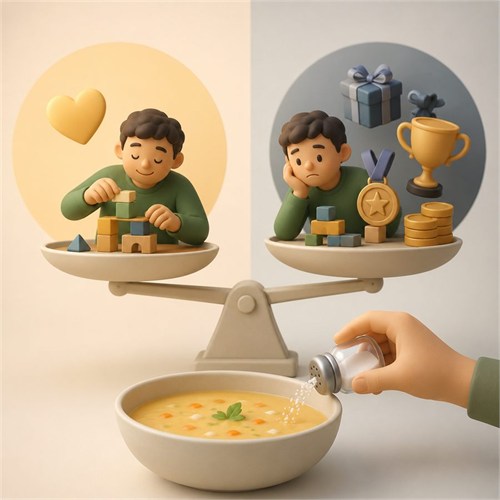
Overjustification Effect illustration
Motivation psychology; cognitive bias / behavioral effect

Overjustification Effect

Do not add heavy external rewards to activities people already enjoy unless necessary. Preserve autonomy, meaning, and mastery first; use rewards carefully, like salt in soup—too much and everyone notices for the wrong reason.

Popularity
Usefulness
Aliases
Overjustification Hypothesis / Undermining Effect / Motivational Crowding Out / Reward Undermining Effect
Domains
Social psychology / educational psychology / organizational behavior / behavioral economics / self-determination theory

Definition

  • The overjustification effect is the tendency for a person’s intrinsic motivation for an already enjoyable activity to decrease after expected external rewards are introduced, especially when the reward makes the person reinterpret the activity as something done “for the reward” rather than for its own sake. (Semantic Scholar)

Core Idea

  • When an activity already has an internal reason, adding a strong external reason can shift perceived control from “I do this because I like it” to “I do this because I get something.” After the reward is removed, the original interest may weaken.

How It Works

  • A person initially performs an activity because it is interesting, enjoyable, or meaningful.
  • An external incentive is introduced, such as money, prizes, grades, certificates, or public rewards.
  • The person begins to explain their own behavior by the external incentive.
  • The activity becomes associated with external control rather than internal choice.
  • When the incentive disappears, the person may show less voluntary interest than before.
  • The effect is most relevant when the activity already had high intrinsic interest and the reward is expected, tangible, or controlling. Meta-analytic evidence suggests expected tangible rewards can undermine free-choice intrinsic motivation, while the size and conditions of the effect are debated. (PubMed)

Usage Example

  • A child enjoys reading storybooks. A parent starts paying the child for every book completed. The child may begin reading mainly for payment, and later may read less when payment stops.
  • This is a likely overjustification case only if the child already enjoyed reading before the reward was introduced.

Famous Example

  • Example: In the classic “magic marker” / drawing study, Lepper, Greene, and Nisbett studied preschool children who already showed interest in drawing. Children who expected an award for drawing later spent less free-choice time drawing than comparison groups. (Heart of Character)
  • Why it fits this rule: The expected reward appeared to shift the children’s reason for drawing from internal enjoyment to an external award.
  • Verification status: Verified as a published 1973 field experiment, but popular retellings are often simplified. The verified finding concerns expected extrinsic reward for an already interesting activity, not “all rewards are always bad.”

Use Cases / Situations Where It Applies

  • Designing reward systems for children, students, employees, creators, or volunteers.
  • Avoiding unnecessary rewards for activities people already enjoy.
  • Understanding why gamification, badges, bonuses, or prizes may reduce long-term interest if used carelessly.
  • Planning education or workplace incentives where autonomy and intrinsic interest matter.
  • Explaining why praise that feels informational may work differently from rewards that feel controlling.

When Not to Use or Common Misuse

  • Do not use it to claim that all rewards reduce motivation; evidence is conditional and debated. Cameron and Pierce’s meta-analysis argued that rewards do not generally reduce intrinsic motivation, while Deci, Koestner, and Ryan’s meta-analysis found undermining effects especially for expected tangible rewards. (Sage Journals)
  • Do not apply it strongly when the person had little or no intrinsic interest at the start.
  • Do not confuse it with simple bribery, laziness, or loss of discipline.
  • Do not assume verbal praise has the same effect as money or prizes; some research distinguishes informational positive feedback from controlling tangible rewards. (Self-Determination Theory)
  • Do not use it as an excuse to remove fair compensation for work. Paid work can still be meaningful; the issue is how rewards affect perceived autonomy and motivation.

Rule Invention / Origin

  • Invented by: No single inventor is fully agreed upon. The named “overjustification hypothesis” is strongly associated with Mark R. Lepper, David Greene, and Richard E. Nisbett’s 1973 study, which drew on self-perception theory. Earlier related experimental work on rewards and intrinsic motivation was done by Edward L. Deci in 1971. (Semantic Scholar)
  • Year of invention: 1973 for the published “overjustification hypothesis”; 1971 for important earlier intrinsic-motivation reward research.
  • Country / context of origin: United States; experimental social psychology and motivation research.

Evidence / Research Basis

  • Lepper, Greene, and Nisbett’s 1973 field experiment tested whether extrinsic rewards could undermine children’s intrinsic interest in drawing. (Heart of Character)
  • Deci’s 1971 research found that some externally mediated rewards could reduce intrinsic motivation, while verbal reinforcement could have different effects. (Self-Determination Theory)
  • Deci, Koestner, and Ryan’s 1999 meta-analysis of 128 studies found that expected tangible rewards and some reward contingencies undermined free-choice intrinsic motivation. (PubMed)
  • Cameron and Pierce’s 1994 meta-analysis reached a more limited conclusion, arguing that rewards do not generally decrease intrinsic motivation and that negative effects occur under narrower conditions. (Sage Journals)
  • Later reviews continue to treat the effect as real but context-dependent rather than universal. (PMC)

Short Practical Takeaway

  • Do not add heavy external rewards to activities people already enjoy unless necessary. Preserve autonomy, meaning, and mastery first; use rewards carefully, like salt in soup—too much and everyone notices for the wrong reason.