Social psychology metaphor; Group behavior pattern; Negative comparison mindset
Social psychology metaphor; Group behavior pattern; Negative comparison mindsetCrab Effect
When someone rises, learn from them or support them; pulling them down rarely lifts anyone up.
Popularity
Usefulness
Aliases
Crab Effect / Crabs in a Bucket Mentality / Crab-Bucket Effect / Crab Barrel Syndrome / Crab Syndrome / Pull-Down Syndrome / Utak Talangka / Isip Talangka, in Filipino / Tagalog contexts (effectiviology.com)
Domains
Psychology / Organizational behavior / Education / Workplace culture / Community and family dynamics
Definition
- Crab Mentality describes a mindset or behavior pattern in which people discourage, undermine, or “pull down” someone who is improving, succeeding, or escaping a bad situation, especially when the attacker gains little or no direct benefit from doing so. (effectiviology.com)
Core Idea
- The core idea is: “If I cannot rise, you should not rise either.”
- It is usually about envy, insecurity, comparison, resentment, or zero-sum thinking rather than fair criticism or healthy competition.
How It Works
- A person sees another person improving, gaining status, or escaping a shared limitation.
- That improvement triggers comparison, insecurity, jealousy, or fear of being left behind.
- Instead of learning from the successful person, the person tries to reduce, mock, block, or sabotage them.
- In a group, this can become a culture where ambition is punished and mediocrity is protected.
Usage Example
- In a workplace, an employee starts improving their skills and becomes a candidate for promotion. Instead of supporting them, some colleagues spread rumors, mock their effort, or say they are “showing off,” even though those colleagues do not directly gain from stopping them.
Famous Example
-
Example:
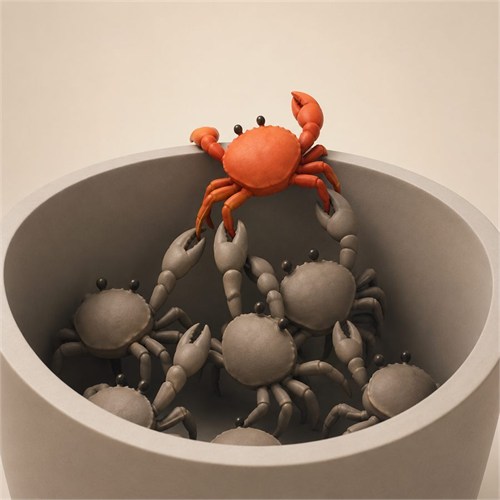
- The common story says that when one crab is placed in an open basket or bucket, it may crawl out; but when several crabs are placed together, any crab trying to escape is pulled back down by the others, so none escape.
-
Why it fits this rule:
- The image is used as a metaphor for people in the same difficult situation preventing one another from escaping or improving.
-
Verification status:
- Partly verified as a widely repeated metaphor, but the exact original story and its biological accuracy are not well verified. Reliable sources describe the crab story as a metaphor or anecdotal observation rather than a formally proven psychological law. (Wikipedia)
Use Cases / Situations Where It Applies
- A peer group mocks someone for studying, saving money, exercising, or changing habits.
- A team resists one member’s improvement because it makes others feel exposed.
- A community discourages someone from leaving poverty, addiction, debt, or a low-status role.
- Family or friends shame someone for becoming more independent.
- Online communities attack people who achieve visibility or success.
When Not to Use or Common Misuse
- Do not use it to dismiss valid criticism.
- Do not label every disagreement as Crab Mentality.
- Do not use it when someone is opposing harmful, unethical, or arrogant behavior.
- Do not confuse it with normal competition where the person expects a direct strategic benefit.
- Do not use it as a stereotype against a whole culture or nationality; sources note that although it is often discussed in Filipino contexts, it is not exclusive to Filipinos. (effectiviology.com)
Rule Invention / Origin
-
Invented by:
- Unknown
-
Year of invention:
- Unknown
-
Country / context of origin:
- Unknown. The phrase is often associated with the “crabs in a bucket / basket / barrel” metaphor and is frequently discussed in Filipino / Tagalog contexts as utak talangka, but no single verified inventor or first year was found. (SAGE Journals)
Evidence / Research Basis
- Crab Mentality is better treated as a social-behavior metaphor than as a formal scientific law.
- Research under terms such as “Crab Barrel Syndrome” links the behavior to social comparison, competition, low self-esteem, jealousy, anxiety, workplace conflict, and organizational behavior. (PMC)
- One 2022 study in Frontiers in Psychology examined Crab Barrel Syndrome using social comparison theory and found relationships involving Type A personality, social comparison, and self-esteem. (PMC)
- The research base appears limited compared with major established psychological theories, so the concept should be used carefully. (PMC)
Short Practical Takeaway
- When someone rises, learn from them or support them; pulling them down rarely lifts anyone up.