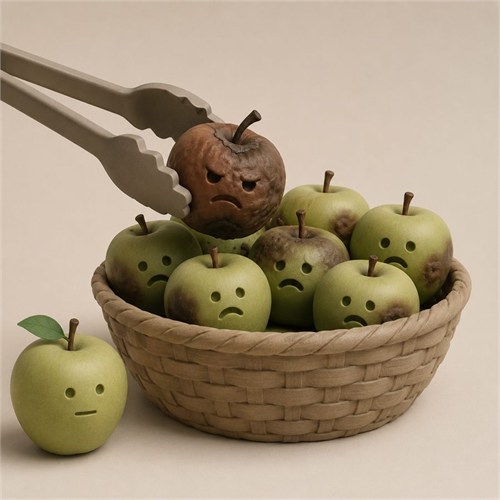
Bad Apple Rule illustration
Social psychology / organizational behavior principle

Bad Apple Rule

Deal with repeated harmful behavior early. One tolerated “bad apple” can quietly teach the whole basket how to rot.

Popularity
Usefulness
Aliases
Bad Apple Effect / Bad Apple Phenomenon / One Bad Apple Spoils the Barrel / Rotten Apple Effect
Domains
Team management, workplace behavior, leadership, ethics, group dynamics, organizational culture

Definition

  • The Bad Apple Rule is the idea that one persistently negative, unethical, lazy, or disruptive member can damage the morale, trust, cooperation, and performance of a whole group.

Core Idea

  • A single harmful member can have an outsized negative effect on a team because negative behavior spreads through attention, emotion, imitation, reduced trust, and defensive reactions.

How It Works

  • One person repeatedly shows harmful behavior, such as withholding effort, expressing constant negativity, or violating interpersonal norms.
  • Other members notice the behavior and may feel unfairness, frustration, reduced trust, or threat.
  • The group may respond with withdrawal, conflict, lower cooperation, or reduced creativity.
  • If leaders ignore the issue, the behavior may become normalized and damage the wider culture. Felps, Mitchell, and Byington identify withholding effort, negative affect, and interpersonal norm violation as key “bad apple” behaviors in groups. (ScienceDirect)

Usage Example

  • In a software team, one senior developer constantly dismisses others’ ideas, refuses code reviews, and blames teammates for bugs. Over time, junior developers stop speaking up, collaboration drops, and the team’s delivery quality declines.

Famous Example

  • Example: The proverb “one bad apple spoils the barrel.”
  • Why it fits this rule: The proverb expresses the idea that one corrupting influence can damage a larger group. Merriam-Webster notes that the original proverb means the opposite of the modern “just a few bad apples” excuse: one bad apple can spoil the whole barrel. (merriam-webster.com)
  • Verification status: Verified as a long-standing English proverb and metaphor. No single inventor is verified.

Use Cases / Situations Where It Applies

  • Small teams with high interdependence.
  • Workplaces where one person’s behavior strongly affects morale.
  • Teams where leaders tolerate repeated disrespect, laziness, bullying, or unethical conduct.
  • Cultures where bad behavior is copied because it appears rewarded or unpunished.
  • Safety-critical teams where poor cooperation can create operational risk.

When Not to Use or Common Misuse

  • Do not use it to blame one person for a systemic problem without checking the wider environment.
  • Do not use it as an excuse to avoid examining leadership, incentives, workload, policies, or culture.
  • Do not confuse it with the “few bad apples” defense, which suggests the problem is isolated and does not affect the whole group. That defensive use is often the reverse of the original proverb. (merriam-webster.com)
  • Do not label someone a “bad apple” based on one mistake, personality difference, or unpopular opinion.

Rule Invention / Origin

  • Invented by: Unknown. It comes from a proverb/metaphor, not a formally invented scientific law.
  • Year of invention: Unknown. Versions of the proverb existed before modern organizational psychology; Benjamin Franklin used the wording “The rotten Apple spoils his Companion” in Poor Richard’s Almanack. (merriam-webster.com)
  • Country / context of origin: English-language proverb tradition; later adapted into organizational behavior and management research.

Evidence / Research Basis

  • The strongest modern research basis is the 2006 organizational behavior review by Will Felps, Terence R. Mitchell, and Eliza Byington, “How, when and why bad apples spoil the barrel: negative group members and dysfunctional groups,” published in Research in Organizational Behavior. (RePub)
  • The paper presents an integrative model explaining how one negative group member can harm teammates through perceptions of inequity, negative feelings, reduced trust, defensive behavior, and weakened group processes such as cooperation and creativity. (RePub)
  • The concept is best treated as a practical organizational-behavior principle, not a mathematical law.

Short Practical Takeaway

  • Deal with repeated harmful behavior early. One tolerated “bad apple” can quietly teach the whole basket how to rot.